A resistive load bank tests real power (kW) at a power factor of 1.0. That unity value, a power factor of 1, means the load draws only real power. A reactive load bank tests reactive power (kVAR) by simulating inductive or capacitive loads, often at a power factor of 0.8. These load banks serve different purposes, and the distinction matters for anyone performing load bank testing on generators, UPS systems, or other power equipment. The wrong type leaves equipment under-tested or produces misleading results. A reactive load stresses voltage regulation and excitation systems; a resistive unit cannot. Technicians who skip this step risk wasted testing time and false confidence in the equipment.
Key Takeaways
- A resistive load bank tests real power (kW) at a power factor of 1.0, simulating loads like lights and heaters.
- A reactive load bank tests reactive power (kVAR) at a power factor of 0.8, simulating motors and transformers.
- Resistive load banks are good for routine generator maintenance and preventing wet stacking.
- Reactive load banks are essential for testing voltage regulation and excitation systems in critical systems.
- Combined load banks provide the most realistic testing by applying both real and reactive loads together.
What Is a Load Bank?
A load bank is a device that applies a controlled, artificial electrical load to a power source. Engineers use it to verify capacity, performance, and reliability without connecting the equipment to a live facility load. The unit absorbs the energy the source produces and dissipates it as heat or a magnetic field. This setup lets technicians push a generator or UPS system to its rated output on demand, in a safe and repeatable way.
Purpose of Load Bank Testing
Load bank testing confirms that a power source can carry its rated capacity and run efficiently. The test reveals operational issues before they surface in service. A generator or UPS system rarely sees full or sustained load during normal operation, so hidden faults can stay dormant until an outage exposes them. Controlled load testing brings those weaknesses into view.
The practice delivers several concrete benefits:
-
Verifying that a generator sustains full power for extended periods, not just a light-load start
-
Preventing wet stacking in diesel units by burning off unburned fuel, carbon, and soot
-
Stressing voltage regulators, cooling, fuel delivery, and exhaust subsystems at the same time
-
Confirming readiness for mission-critical sites such as data centers and hospitals
-
Meeting NFPA 110 annual testing mandates and insurance or fire code obligations
Why Load Type Matters
Resistive and reactive load banks are the two main methods for testing standby generator sets. The type chosen determines what the test actually proves. A resistive unit validates real power in kW. A reactive unit validates apparent power in kVA and the system's response to lagging current. Neither substitutes for the other.
Test accuracy also depends on how the load is applied. A sound plan steps through 25, 50, 75, and 100 percent of nameplate rating with dwell times at each level. Generator sets load bank testing procedures should follow this pattern.
Resistive load testing standby generators proves kW capacity and thermal behavior. Load testing a generator with reactive load proves excitation and voltage control. Combined load banks prove both at once.
What Is a Resistive Load Bank?
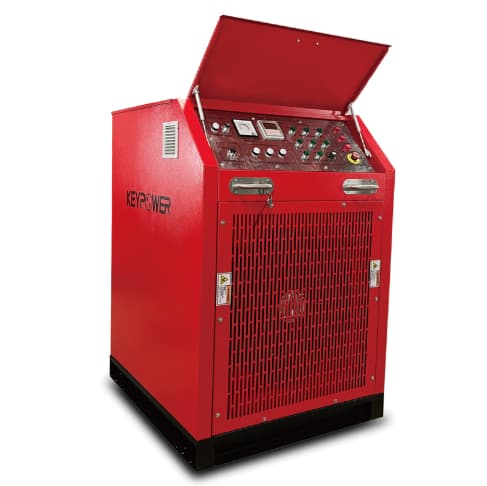
A resistive load bank converts electrical energy into heat through power resistors. This heat dissipates by air or water, using forced means or convection. The unit presents a power factor of 1.0 load and simulates real power consumption in kW. Resistive loads consume real power without any phase shift. This simplicity makes power consumption easier to calculate and manage.
How It Works
The resistive load bank uses resistor banks to draw current in phase with the voltage. A power factor of 1 means the load draws only real power. Pure resistive loads, such as incandescent lighting and resistive heating elements, behave the same way. The bank steps through load levels to stress the power source. Technicians monitor voltage, current, and temperature at each step. The unit assesses kW capacity and thermal performance. It does not test reactive power effects that stress voltage regulation and excitation systems.
Resistive Load Bank Applications
Resistive load banks serve several testing goals. Common uses include:
-
Testing generators at rated capacity
-
Verifying system performance after installation
-
Conducting regular maintenance to prevent wet stacking
|
Application |
Purpose |
|---|---|
|
Full load testing |
Applies up to 100% load at power factor 1.0 to verify a power source's response under full load |
|
Wet stacking prevention |
Applies higher-than-typical load to burn off engine buildup caused by operating at 50% load or lower |
|
Performance optimization |
Supplements the actual load to prevent/clear wet stacking and treat exhaust fumes, keeping internal systems clear |
Load bank testing with a resistive unit confirms kW capacity. Load banks of this type suit routine maintenance checks. Resistive load bank testing alone leaves reactive effects untested. Engineers who need full verification pair load banks for complete coverage.
What Is a Reactive Load Bank?
A reactive load bank simulates inductive and/or capacitive loads. It converts electrical energy into a magnetic field instead of heat. This behavior lets the unit test kVA capacity under varying power factors. The equipment reproduces the phase shift between voltage and current that real magnetic devices create. Technicians use it to verify how a power source handles current that does not stay in step with voltage.
How It Works
The unit combines reactor coils and capacitor banks to shift current out of phase with voltage. Inductive elements make current lag voltage, while capacitive elements make current lead. The table below shows how each type behaves.
|
Load Type |
What It Simulates |
Phase Relationship |
Reactive Power Effect |
|---|---|---|---|
|
Inductive (L) |
Devices with coils creating magnetic fields, e.g., motors and transformers |
Current lags voltage |
Consumes reactive power |
|
Capacitive (C) |
Components storing energy in an electric field, e.g., capacitor banks or electronic devices |
Current leads voltage |
Produces reactive power with a different phase relationship than inductive loads |
By combining resistive, inductive, and capacitive elements, the load bank reproduces the complex real-world loads found in electrical systems. Operators can set the unit to inductive (lagging) or capacitive (leading) power factors. This flexibility separates reactive load bank testing from simple resistive checks.
Reactive Load Bank Applications
Reactive load banks replicate a lagging or leading power factor. That capability is vital for complete engine and alternator tests. The alternator must hold voltage steady while current lags, and only a reactive load exposes weak excitation response. Reactive load bank testing also emulates motor-type loads and verifies power factor, which matters for UPS and data center commissioning.
A reactive load bank does not test a system at full load on its own. The unit stresses the reactive side of performance, not the full apparent power range. Engineers pair inductive load banks or capacitive load banks with resistive units for complete coverage. Used alone, reactive load banks confirm excitation and voltage regulation but leave kW capacity unproven.
Resistive vs Reactive Load Banks: Key Differences
Power Factor and Load Simulation
The clearest split between these two load bank types sits in the power factor they present. A resistive load bank draws current in phase with voltage and holds a power factor of 1. That unity value means the unit consumes only real power, measured in kW. A reactive load bank shifts current out of phase and typically runs at a lagging power factor of 0.8. The unit consumes reactive power, measured in kVAR, and stresses the excitation system in a way a resistive unit cannot.
This difference shapes what each test simulates. A resistive load bank mimics lighting, heaters, and the unity component of motor loads. A reactive load bank mimics motors, transformers, and other magnetic devices. The power factor of the system under test therefore decides which unit tells the truth about performance.
Testing Capabilities Compared
The two designs prove different things, and each leaves a gap the other fills. Resistive load bank testing verifies that the genset produces 100% output at 1.0 power factor, confirming the engine and system hold full load without overheating. It also checks oil, fuel, and critical engine systems, and burns out carbon deposits to prevent wet stacking. Typical test duration runs up to 8 hours, with 18–24 hours for some government and military requirements.
Reactive load bank testing measures the full kVA nameplate rating at 0.8 power factor. The reactive load supplies about 75% of the resistive rating and runs in parallel with the resistive load bank. This setup confirms proper calibration of load sharing and voltage regulating systems in parallel installations. A resistive-reactive 0.8pf loadbank therefore covers both sides at once.
|
Testing Aspect |
Resistive-Only Load Bank |
Resistive/Reactive Load Bank |
|---|---|---|
|
Rating verified |
Full kW output at 1.0 PF |
Full kVA at 0.8 PF |
|
Transient voltage dip |
May not reveal sensitivity; solid-state controls can shut down |
Reveals roughly 25% greater initial voltage dip at 75% load, 0.80 PF |
|
Reactive load sharing |
Can fail to show how one generator accepts reactive load |
Verifies equal kVAR sharing and load-sharing control setup |
|
Real-world simulation |
Less realistic |
Closer match to voltage drop, heating, harmonics, and efficiency |
|
Cost |
Lower |
More costly |
|
Recommended use |
Routine testing, carbon burn-off, wet stacking prevention |
New installations, critical systems with large motor loads |
The comparison exposes the core limitation on each side. Resistive testing alone does not reveal how a system handles reactive power. Reactive testing alone does not apply full real-power load. Reactive load banks also cost more, so engineers reserve them for new installations and critical standby generators with large motor loads. Generator kVA rarely deteriorates once proven, which makes routine resistive checks the practical default. The resistive vs. reactive choice, in short, comes down to whether the test must prove kW capacity or kVA behavior under a lagging load.
Combined Load Bank Testing
Why Realistic Testing Needs Both
Combined resistive/reactive load banks apply real and reactive load together. This pairing produces the most realistic simulation of real-world conditions. Field loads rarely sit at unity power factor. Motors, transformers, and magnetic devices pull current out of phase with voltage. A test that ignores this behavior tells only half the story.
A combined unit closes that gap. The equipment can test at non-unity power factor (lagging). It can also test the generator set fully at 100% nameplate kVA rating. Resistors and inductors switch independently, so operators can run resistive only, inductive only, or varying lagging power factor testing. Capacitive functions are also available if specified. This approach supports complete engine and alternator testing across the full apparent power range.
The benefits fall into three areas:
-
Full power factor testing
-
Realistic system validation
-
Compliance with international standards
When to Choose a Combined Unit
A combined resistive and reactive load bank suits commissioning work and critical standby systems. New installations with large motor loads demand proof of voltage regulation under lagging current. Parallel generator sites need verified kVAR sharing. Combined resistive / reactive load banks cover both needs in one test run.
Routine maintenance rarely justifies the extra cost. A resistive-only unit handles carbon burn-off and wet stacking prevention well. Engineers reserve reactive load bank testing for cases where excitation response matters. Sites that expect changing load profiles should weigh the flexibility of a combined unit. The independent switching of resistors and inductors lets one machine serve several test plans. Buyers should confirm the required power factor, the kVA range, and whether future projects will need capacitive capability. Combined load banks then deliver lasting value across the equipment fleet.
Is a Resistive Load Bank Enough?
A resistive load bank is sufficient for kW capacity checks. It proves that a generator sustains real power and that the engine, cooling, and fuel systems hold up under thermal stress. It leaves reactive power effects on voltage regulation and excitation systems untested. That gap matters whenever the site runs motors, transformers, or other magnetic loads.
What Resistive-Only Testing Misses
Resistive load bank testing reproduces real-power loads such as lighting and heating elements. It does not reproduce reactive power behavior. The generator never sees lagging or leading current, so its response to either condition stays unknown.
|
Missed Effect |
Technical Mechanism |
Consequence of Resistive-Only Testing |
|---|---|---|
|
Inductive (lagging) reactive power |
Inductive reactance opposes current changes via magnetic fields |
Motor and transformer-like lagging loads are not simulated |
|
Capacitive (leading) reactive power |
Capacitive reactance opposes voltage changes via electric fields |
Leading power factor conditions are not simulated |
|
Phase displacement |
Reactive loads push voltage out of phase with current, up to 90° for pure reactance |
Phase-shift response and harmonic effects go untested |
|
Power factor variation |
Combined loads enable testing at specific power factors, such as 0.8 lagging or leading |
The generator is not evaluated at rated power factor |
Without reactive load bank testing, the unit is never assessed at its rated power factor. Efficiency impacts tied to power factor therefore stay hidden.
Risks of Incomplete Load Bank Testing
Incomplete testing produces misleading pass results. A unit can run cleanly at unity power factor and still fail in service.
Voltage stability at rated load signals alternator and regulator health. Faulty regulators or alternator windings stay undiagnosed when load bank testing skips the reactive side. Load-transition behavior also remains unconfirmed. Operators then carry false confidence into an outage. Pairing reactive load banks with resistive units closes the gap.
Choosing Resistive or Reactive Load Banks
Matching the Load Bank to Your Equipment
The equipment under test sets the testing objective, and the objective decides the load bank type. A generator needs proof of kW capacity and voltage regulation. A UPS system needs proof of performance under distorted, non-linear load. Data centers and telecom sites often run parallel generators, which adds reactive load sharing to the list.
Resistive load banks suit generator testing, UPS testing, and routine maintenance. Their simple construction keeps them cost-effective for preventative work such as carbon burn-off. Reactive load banks provide inductive or capacitive loads to UPS systems, transformers, and motors. Teams choose them where power factor and reactive behavior matter.
|
Equipment Type |
Recommended Load Bank |
Rationale |
|---|---|---|
|
Generators |
RLC load bank |
Adjustable power factor checks voltage regulation, AVR and governor stability, and true kVA performance |
|
UPS systems (data center, double-conversion) |
RCD load bank |
Simulates realistic non-linear loads and verifies harmonic handling |
|
Comprehensive system validation |
Combined RLC + RCD |
Switches between linear and non-linear modes for full validation |
A resistive unit assesses a generator's kW capacity. A reactive unit tests kVA capacity under varying power factors. Generator testing therefore benefits from reactive capability whenever power-factor behavior matters. Parallel generator sites make that capability essential.
KEYPOWER illustrates how a single supplier can cover both paths. Established in 1998, the company runs a factory over 66,000 square meters with an annual capacity of 5,000 units. Its global network covers more than 100 countries, and it holds OEM, CE, and ISO certification. KEYPOWER offers load banks in resistive and inductive types alongside diesel generators from 6 kVA to 4375 kVA, compatible with Cummins, Perkins, MTU, Volvo, and other engine brands.
Questions to Ask Before You Buy
Buyers should confirm the continuous kW and kVA rating first. They should then verify the voltage and frequency range, the minimum load step size, the duty cycle, the cooling method, portability, and data logging needs. These details decide whether the unit matches the test plan without overheating or underperforming.
Power factor deserves its own line of questioning. Most diesel generators are rated at PF 0.8, and the relation kW = kVA × PF converts between the two. Lagging PF comes from inductive loads such as motors and transformers, and generators handle it efficiently. Leading PF comes from capacitive loads such as capacitor banks and batteries, and it can cause voltage instability. Buyers should confirm the load's PF type and consult an electrical engineer to avoid a mismatch between generator rating and connected load.
A short checklist keeps the conversation productive:
-
Does the kW/kVA coverage match current test needs, and can it expand?
-
Is the unit rated for continuous or intermittent duty?
-
Are over-temperature, overload, and short-circuit protections included?
-
Are test reports, certificates, and manuals provided?
-
Is buy, rent, or outsourced support available?
For generator maintenance, a resistive load bank is typically the most common choice. It applies real power, verifies output under load, and supports thermal checks. If the application also requires power factor or UPS validation, buyers should ask about a reactive or resistive-reactive model instead. That single question separates a adequate purchase from the right one.
A resistive load bank tests real power at a power factor of 1.0. A reactive load bank tests reactive power at a power factor of 0.8. Combined units deliver the most realistic simulation.
The right choice depends on the equipment and the testing objectives. A generator needing only kW verification may suit a resistive unit. Critical systems with large motor loads often demand reactive load testing too.
Readers should assess their application needs first. They can then consult an expert to confirm the correct configuration. Load banks vary in rating and power factor, so expert guidance prevents a costly mismatch. Contact a qualified supplier for a tailored recommendation.
FAQ
Which load bank type suits routine generator maintenance?
A resistive load bank fits most routine maintenance work. It applies real power at a power factor of 1.0, verifies kW output, and burns off carbon deposits that cause wet stacking. Teams reserve reactive testing for commissioning or sites with large motor loads.
Can a reactive load bank replace a resistive unit?
No. A reactive load bank stresses excitation and voltage regulation at a lagging power factor, often 0.8. It does not apply full real-power load on its own. Complete verification requires both types, either as separate units or as one combined machine.
What power factor should a buyer specify?
Most diesel generators carry a nameplate rating at PF 0.8. Buyers should match the load bank to that rating and confirm whether the site runs inductive loads such as motors and transformers. An electrical engineer can confirm the correct configuration before purchase.
How does load bank testing support NFPA 110 compliance?
NFPA 110 requires annual testing of emergency power supply systems. Load bank testing provides the controlled, measurable load that this standard expects. A resistive unit covers the kW checks, and a combined unit adds reactive verification for critical facilities.
Does KEYPOWER supply both load bank types?
Yes. KEYPOWER offers load banks in resistive and inductive types. The company also builds diesel generators from 6 kVA to 4375 kVA, compatible with Cummins, Perkins, MTU, and Volvo engines. Its global network covers more than 100 countries.